
The FIFA World Cup 2026 stage is set for the most ambitious tournament in history.
In just a few months, the world’s most-watched sporting event will kick off across North America, uniting three nations, 16 cities, 48 teams, and billions of fans in a celebration of football unlike anything we’ve witnessed before. From the opening match on June 11, 2026, at the historic Estadio Azteca in Mexico City to the final on July 19 at MetLife Stadium in New Jersey, the 2026 FIFA World Cup promises to redefine what a global sporting event can be.
This isn’t just another World Cup — the FIFA World Cup 2026 is a tournament of firsts and superlatives that will reshape football’s landscape for generations to come.
For the first time in history, three countries will co-host the FIFA World Cup 2026. A record 48 teams will compete — up from 32 — across 104 matches spanning 39 days and a vast continental geography. The tournament is projected to generate between $11 billion and $17 billion in economic impact, attract over 6.5 million spectators, and create nearly 300,000 jobs across the host nations.
Whether you’re a die-hard football fan planning to attend matches in person, a casual observer curious about the hype, or simply wanting to understand this global phenomenon, this comprehensive guide has you covered.
From host cities and stadium innovations to tickets, travel tips, and the cultural significance of this historic event — we’ve got you covered.
Let’s explore why June and July 2026 will mark one of the most extraordinary chapters in sports history.
Why the 2026 World Cup Is Historic
The 2026 FIFA World Cup represents a turning point in how the world’s biggest sporting event is conceived, organized, and experienced.
First-Ever Three-Nation Host
This marks the first time in World Cup history that three countries will jointly host the tournament. While Japan and South Korea co-hosted in 2002, the 2026 edition takes multinational collaboration to an unprecedented level, spanning three distinct nations across a continent.
The joint United bid beat Morocco’s solo proposal at the 68th FIFA Congress in Moscow in 2018, securing a comfortable majority with over 100 votes. The decision set the path for what organizers call “the most geographically spread World Cup in history.”
This tri-national partnership demonstrates remarkable international cooperation between the United States, Canada, and Mexico—neighboring countries with deep cultural connections and a shared passion for football. The collaboration extends beyond just sharing hosting duties; it represents a model for future large-scale sporting events that can distribute economic benefits and logistical challenges across multiple nations.
Historic Milestones for Each Host Nation
Mexico’s Third Time Hosting: Mexico will become the first country ever to host or co-host the men’s World Cup three times, having previously hosted in 1970 (when Brazil’s legendary team led by Pelé triumphed) and 1986 (when Diego Maradona’s “Hand of God” and “Goal of the Century” became eternal World Cup moments).
Canada’s Men’s Tournament Debut: Canada will host the men’s World Cup for the first time, though they previously hosted the 2015 Women’s World Cup. This makes Canada the fifth country to host both men’s and women’s World Cups.
U.S.’s Return After 32 Years: The United States will host a men’s World Cup for the second time (first in 1994) and will become the first country to host men’s and women’s World Cups on two separate occasions (1994, 2026; 1999, 2003). The 1994 World Cup was a watershed moment that introduced millions of Americans to global football and laid the foundation for Major League Soccer.
Expansion to 48 Teams
For 20 years, the World Cup featured 32 teams. Starting in 2026, that number jumps to 48—a 50% increase that fundamentally changes the tournament’s dynamics.
This expansion means:
- More nations get to experience football’s ultimate stage
- Underdog stories become more common
- Geographic representation becomes more equitable
- Emerging football nations receive global exposure
- The tournament extends from 32 to 39 days
- Total matches increase from 64 to 104
The 48-team format has been met with both excitement and skepticism. Supporters argue it democratizes the World Cup, giving more countries a chance at glory. Critics worry about quality dilution. Regardless of the debate, the expansion is a done deal, and it will fundamentally alter World Cup dynamics.
Record-Breaking Scale
The numbers tell the story of just how massive this tournament will be:
- 16 host cities across three nations (compared to typically 8-12 in previous tournaments)
- 104 matches (vs. 64 in Qatar 2022)
- 39 days of competition (vs. 29 in 2022)
- 6.5 million expected spectators in stadiums
- 5+ billion television viewers projected globally
- Over $40 billion in GDP impact across the three host nations
- Nearly 300,000 jobs created
- Three time zones managed simultaneously
As FIFA President Gianni Infantino declared during the December 2025 draw ceremony: “It’s the greatest event that humanity, that mankind has ever seen and will ever see.”
While undeniably hyperbolic, the statement captures something of the unprecedented scale and ambition of this tournament. The 2026 World Cup will be the largest single-sport event in history—eclipsing even the Summer Olympics in scale, viewership, and global reach.
Host Cities Across Three Nations
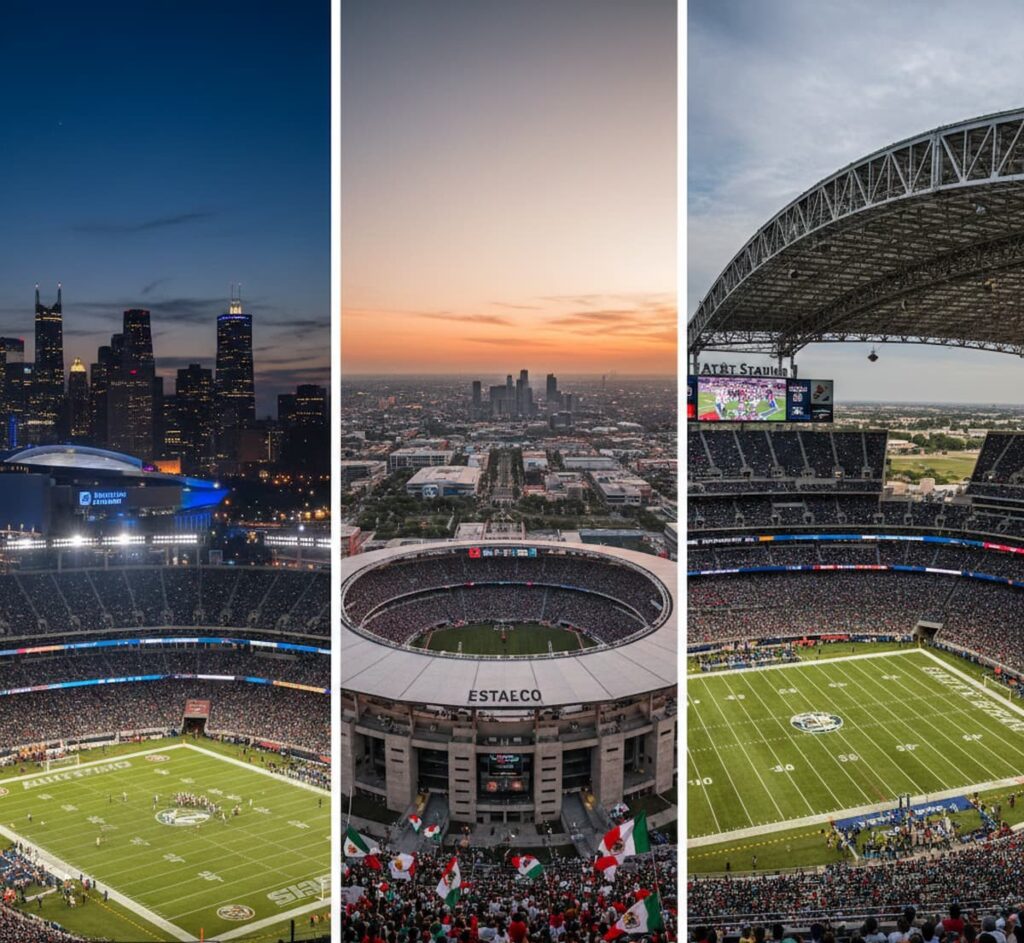
The 16 host cities were carefully selected from 23 potential locations based on logistics, stadium capacity, infrastructure, and ability to deliver world-class fan experiences.
United States (11 Cities)
The U.S. will host the overwhelming majority of matches, with 11 cities selected:
Eastern Region:
- New York/New Jersey (MetLife Stadium) – Hosting the final on July 19, plus 7 other matches
- Philadelphia (Lincoln Financial Field) – Historic sports city
- Boston (Gillette Stadium in Foxborough) – New England’s football stronghold
- Atlanta (Mercedes-Benz Stadium) – Modern venue with retractable roof
- Miami (Hard Rock Stadium) – Tropical destination with strong Latin American connections
Central Region:
- Kansas City (Arrowhead Stadium) – America’s heartland
- Dallas (AT&T Stadium in Arlington) – Hosting a semifinal, capacity up to 105,000
- Houston (NRG Stadium) – Texas’s diverse metropolis
Western Region:
- Los Angeles (SoFi Stadium in Inglewood) – Hosting the USMNT opener on June 12
- San Francisco Bay Area (Levi’s Stadium in Santa Clara) – Silicon Valley’s tech capital
- Seattle (Lumen Field) – Pacific Northwest’s passionate soccer market
Mexico (3 Cities)
Central Region:
- Mexico City (Estadio Azteca) – Hosting the tournament’s opening match on June 11; capacity 83,000
- Guadalajara (Estadio Guadalajara) – Mexico’s second-largest metro area; capacity 48,000
- Monterrey (Estadio BBVA) – Northern Mexico’s industrial capital; capacity 53,500
Canada (2 Cities)
Western Region:
- Vancouver (BC Place) – Pacific coast city; retractable roof stadium
Eastern Region:
- Toronto (BMO Field) – Canada’s largest city; passionate multicultural fan base
Tournament Format Change
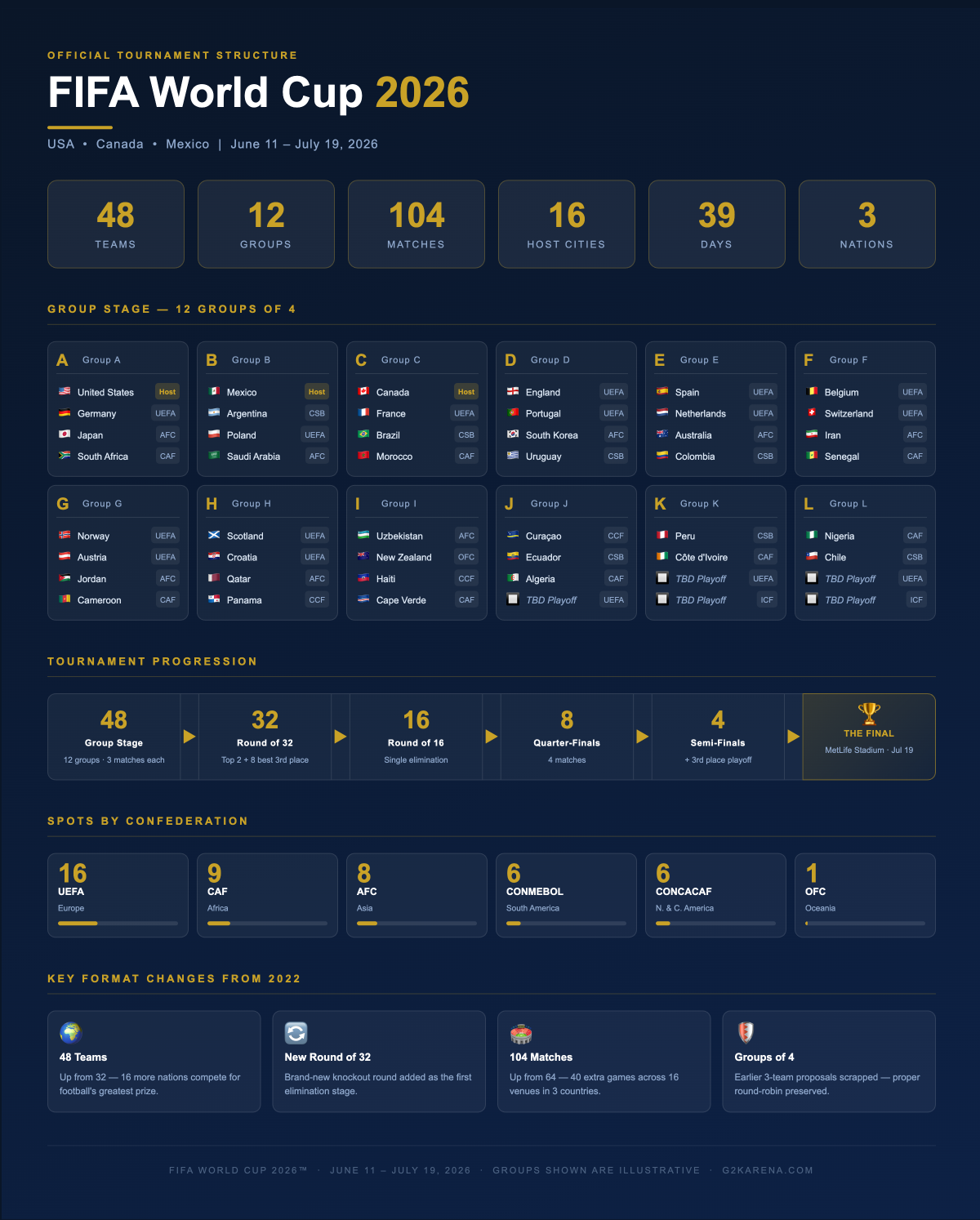
The expansion to 48 teams necessitates a completely new tournament structure.
Group Stage Format
12 Groups of 4 Teams Each:
The 48 teams will be divided into 12 groups (labeled A through L), with 4 teams in each group.
Top Two Plus Best Third-Place Teams Advance:
From each group, the top two teams automatically advance to the knockout rounds. Additionally, the eight best third-place teams across all 12 groups will also progress.
Three Group Matches Per Team:
Each team still plays exactly three group stage matches—just like previous World Cups.
Knockout Stage: New Round of 32
Tournament Structure:
- Round of 32 (24 group winners/runners-up + 8 third-place teams) → 16 teams remain
- Round of 16 → 8 teams remain
- Quarterfinals → 4 teams remain
- Semifinals → 2 teams remain
- Final + Third-Place Match
More Matches for Finalists:
Teams that reach the final will play 8 matches total, an increase from 7 in previous tournaments.
Team Allocation by Confederation
- UEFA (Europe): 16 teams
- CAF (Africa): 9 teams
- AFC (Asia): 8 teams
- CONMEBOL (South America): 6 teams
- CONCACAF (North America): 6 teams (including hosts)
- OFC (Oceania): 1 team
- Intercontinental Playoffs: 2 teams
Top Teams and Players to Watch

The 2026 World Cup will feature an extraordinary collection of talent spanning generations.
Traditional Powerhouses
Brazil – Five-time champions seeking to end their 24-year title drought. Stars: Vinícius Jr., Rodrygo, and a new generation.
Argentina – Defending champions. Will Lionel Messi (age 39) play one last time?
France – 2018 champions led by Kylian Mbappé. Possess perhaps the world’s deepest talent pool.
Germany – Four-time champions rebuilding with young talents like Florian Wirtz and Jamal Musiala.
Spain – 2010 champions rebuilt around Barcelona’s academy products.
England – Seeking their first World Cup since 1966. Led by Harry Kane, Jude Bellingham, and Phil Foden.
Emerging Threats
Netherlands, Portugal, Uruguay, Colombia, Japan, South Korea – All capable of surprising the traditional powers.
Star Players to Watch
Kylian Mbappé (France) – At 27, in his absolute prime. The world’s most expensive player.
Vinícius Jr. (Brazil) – Real Madrid winger evolved into one of the world’s most dangerous attackers.
Jude Bellingham (England) – Real Madrid’s midfield maestro at just 22 years old.
Lionel Messi (Argentina) – If the 39-year-old legend plays, it would be his final World Cup.
Florian Wirtz (Germany) – Germany’s next generational talent.
Lamine Yamal (Spain) – Barcelona’s teenage prodigy (19 in 2026).
CONCACAF Nations
United States – Hosts under immense pressure. Opening match: June 12 vs. Paraguay in Los Angeles.
Mexico – El Tri performing at home with passionate support.
Canada – Building competitive squad with home support advantage.
Economic Impact: Over $5 Billion and Growing

The 2026 FIFA World Cup will generate extraordinary economic benefits.
The Numbers Are Staggering
FIFA-WTO Joint Study Estimates:
- $40.9 billion in global GDP impact
- $17.2 billion in U.S. GDP contribution
- 185,000 jobs created in the U.S.
- 824,000 full-time equivalent jobs globally
Individual Host City Projections:
- New York/New Jersey: $3.3 billion, 26,000 jobs, 1.2 million visitors
- Los Angeles: $594 million, 179,000 visitors
- Dallas: $1.5-2.1 billion, 3.8 million visitors
Tourism: The Primary Economic Driver
6.5 Million Spectators Expected across 104 matches.
1.2 Million International Visitors to U.S. Alone – one of the largest peacetime population movements in history.
Extended Stays Drive Impact:
World Cup tourists typically stay 5-8 days, significantly longer than typical 2-3 day sports event visitors.
Hotel Revenue Explosion:
- Occupancy rates: 90-100% in host cities during match days
- Average daily rates spike: 46-90% above baseline
- Los Angeles: 330,000 incremental room nights
Airbnb Impact:
Airbnb hosts in 16 U.S. cities projected to generate $2.6 billion in revenue.
Jobs Creation Across Sectors
40,000+ Temporary Jobs in:
- Hospitality
- Event management
- Security and safety
- Transportation and logistics
- Construction and stadium preparation
- Retail and merchandise
$1+ Billion in Aggregate Wages
Tax Revenue Windfall
- Los Angeles: $35 million in additional tax revenue
- Significant sales tax from visitor spending
- Long-term tourism tax benefits
The Multiplier Effect
Each dollar of direct spending generates $1.50-$2.00 in total economic activity.
Global Media Exposure Value
$133+ Million in Media Exposure (Los Angeles alone) based on advertising equivalency.
Los Angeles County projects $230.4 million in future tourism revenue from media exposure.
The Bottom Line
The 2026 FIFA World Cup represents one of the largest economic catalysts in modern sports history, leveraging existing facilities to maximize net positive financial outcomes.
Stadium Technology and Innovations

The 2026 World Cup will showcase cutting-edge stadium technology.
The Official Match Ball: “Trionda”
Named “Trionda” (Spanish for “three waves”), featuring colors honoring the three host nations.
Connected Ball Technology:
Contains sensors transmitting data in real-time for:
- Precise ball position tracking
- Faster offside decisions
- Goal-line technology integration
- Impact force measurements
Stadium Capacities and Features
Largest Venues:
- AT&T Stadium (Dallas): 80,000-105,000
- Estadio Azteca (Mexico City): 83,000
- MetLife Stadium (New York/New Jersey): 82,500
Key Features:
- Retractable roofs at several venues
- 5G connectivity throughout
- High-definition video boards
- Premium hospitality sections
- Modern accessibility standards
Fan Experience Technology
- Mobile Ticketing: All digital tickets
- Cashless Payments: Credit cards, mobile payments, RFID wristbands
- Fan Apps: Real-time stats, wayfinding, ordering
- Augmented Reality: Player stats and interactive content
Sustainability Initiatives
- LED lighting
- Renewable energy sources
- Waste reduction programs
- Water conservation
- Public transportation incentives
How to Get Tickets

Getting World Cup tickets requires planning and patience.
Ticket Sales Phases
FIFA manages sales through multiple phases throughout 2025-2026.
2 Million Tickets Already Sold as of December 2025 from 212 countries.
Pricing Structure
Supporter Entry Tier: $60
- Limited allocation through national football associations
- Available even for final match
- Must apply through your country’s FA
Price Range Examples:
- Group stage: $60-$500
- Knockout rounds: $150-$800
- Semifinals: $300-$1,500
- Final: $500-$2,500+
How to Apply
Official FIFA Ticket Portal: FIFA.com/tickets
Process:
- Create FIFA account
- Browse available matches
- Select preferences
- Submit application
- Wait for lottery results
- Complete payment if selected
Tips for Success
- Apply for multiple matches
- Consider lesser-known teams
- Join FIFA volunteer community
- Monitor official channels
What to Avoid
- Unauthorized resellers
- Scam websites
- Only use FIFA.com/tickets
Travel Planning Tips
Planning requires advance preparation due to scale and demand.
Booking Accommodations
Book Extremely Early – hotels experiencing high demand already.
Consider Alternatives:
- Airbnb, VRBO, vacation rentals
- Stay outside host cities and commute
- Nearby cities with transit access
Hotel Rate Increases: 46-90% higher during match days.
Transportation Between Cities
Flights: Domestic flights in high demand – book early.
Rental Cars: Consider for nearby city pairs.
Trains: Limited high-speed rail in U.S.; Amtrak available.
Organized Tours: Packages with transport and tickets bundled.
Getting Around Host Cities
- Public transportation investments for World Cup
- Rideshares (expect surge pricing)
- Walking in downtown areas
- Stay near stadiums or transit lines
Visa and Entry Requirements
U.S.: Check visa requirements (Visa Waiver Program for many countries)
Canada: eTA for air travel
Mexico: Most tourists enter visa-free
Budgeting Your Trip
Budget Travel: $2,000-5,000 for 5-7 days
Mid-Range: $5,000-10,000
Luxury: $10,000-25,000+
Add match ticket costs to estimates.
Safety and Health
- Purchase travel insurance
- Ensure vaccinations current
- Stay hydrated
- Keep valuables secure
Cultural Considerations
Languages:
- U.S.: English (Spanish in some areas)
- Canada: English/French
- Mexico: Spanish
Tipping:
- U.S./Canada: 15-20%
- Mexico: 10-15%
Climate: June-July varies dramatically by region (65-95°F).
Cultural Significance and Legacy
Beyond economics, the 2026 World Cup carries profound cultural significance.
Football’s Growth in North America
The 1994 Effect: Led directly to MLS creation (1996), growing from 10 to 29 teams.
The 2026 Effect Will Be Larger:
- Continued MLS expansion
- Youth participation surge
- Broadcasting rights increase
- Infrastructure expansion
- More North American players in European leagues
Uniting Three Nations
Symbolizes cooperation between neighboring countries with complex histories.
Global Stage for Emerging Nations
48-team format gives more nations global exposure and creates underdog stories.
Cultural Exchange
5 Million+ International Visitors converging will create an extraordinary cultural exchange:
- Fans from different nations socializing
- Host cities experiencing diverse cultures
- Friendships across borders
- Understanding replacing stereotypes
Fan Festivals in each host city with screens, food, music, entertainment.
Inspiration for Youth
Young people watching will be inspired to play. Youth registration surges after World Cups.
The Social Legacy
- Infrastructure improvements
- International recognition
- Economic prosperity
- Cultural pride
- Experience for future events
A Centennial Celebration
2026 comes as football approaches centennial of World Cups (first was 1930).
Timeline and Key Dates
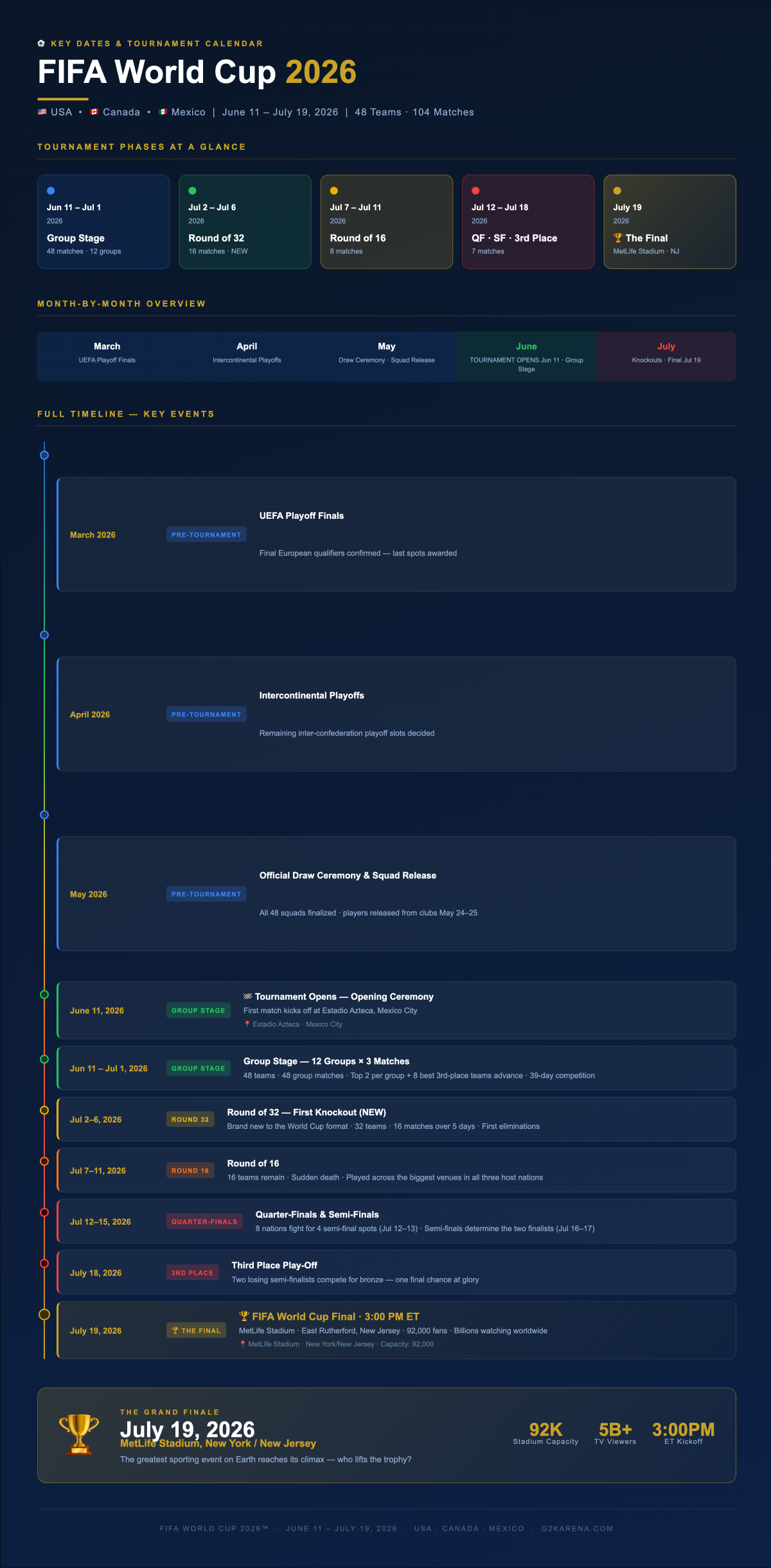
Pre-Tournament
March 2026: Intercontinental playoff matches – final 48 teams confirmed
May 24-25, 2026: Players released from clubs
Early June 2026: Teams arrive at base camps
Tournament Schedule
June 11, 2026 (Thursday):
OPENING MATCH – Estadio Azteca, Mexico City
June 12, 2026 (Friday):
USMNT Opening Match – USA vs. Paraguay, SoFi Stadium, Los Angeles
June 11-27, 2026:
Group Stage – All 48 teams play three matches each
June 29 – July 3, 2026:
Round of 32 – First time since 1986
July 4-8, 2026:
Round of 16
July 9-13, 2026:
Quarterfinals
July 14-15, 2026:
Semifinals – Dallas and Atlanta
July 18, 2026 (Saturday):
Third-Place Match
July 19, 2026 (Sunday):
FINAL MATCH – MetLife Stadium (New York New Jersey), 3:00 PM ET
Coldplay set to perform in a Super Bowl-style halftime show
Conclusion: The World’s Game Comes to North America
The FIFA World Cup 2026 is more than a football tournament — it’s a transformative cultural event that will unite billions of people around the globe.
What Makes 2026 Unprecedented:
- First-ever three-nation host
- Largest tournament with 48 teams
- 104 matches across 39 days
- 16 world-class host cities
- $11-40 billion economic impact
- Nearly 300,000 jobs created
- 6.5 million spectators expected
- 5+ billion viewers globally
The Legacy:
- Football’s growth in North America accelerates
- Infrastructure improvements benefit residents
- Cultural exchange fosters global understanding
- Youth inspiration creates next generation
- Economic prosperity creates opportunities
- Host cities gain international recognition
The countdown is on. The world is watching. North America is ready.
Will you be part of history?
Subscribe to Get 2 Know Arena for ongoing FIFA World Cup 2026 coverage!
Related Reading:
- 10 Trends Shaping 2026: What You Need to Know Right Now
- About Get 2 Know Arena: Your Hub for Everything That Matters
References & Further Reading
Official FIFA Resources:
- FIFA World Cup 2026: https://www.fifa.com/en/tournaments/mens/worldcup/canadamexicousa2026
- FIFA Tickets: https://www.fifa.com/tickets
- FIFA Volunteer: https://www.fifa.com/volunteer
Tournament Information:
- Britannica: https://www.britannica.com/event/2026-FIFA-World-Cup
- FOX Sports: https://www.foxsports.com/soccer/fifa-world-cup
- Sky Sports: https://www.skysports.com/football/world-cup
Economic Impact:
- FIFA-WTO Study: https://inside.fifa.com/organisation/media-releases/fifa-wto-study
- NY-NJ Host Committee: https://nynjfwc26.com
- BCG Analysis: https://gabelli.com/research/beyond-the-pitch-2026-fifa-world-cup
Host Cities:
- Host Cities Guide: https://esim.holafly.com/travel-tips/world-cup-host-cities/
- MLS Schedule: https://www.mlssoccer.com/news/fifa-world-cup-2026-schedule
Travel Resources:
- Skift Travel Podcast: https://skift.com/2025/09/04/the-fifa-world-cup-tourism-strategy
Disclaimer: Get 2 Know Arena is not affiliated with FIFA. Information compiled from official FIFA sources. Subject to change by FIFA.